

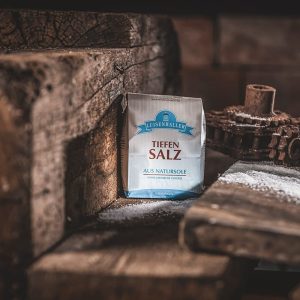
Luisenhaller Deep-Sea Salt, 1000 gr – Fine-Grained
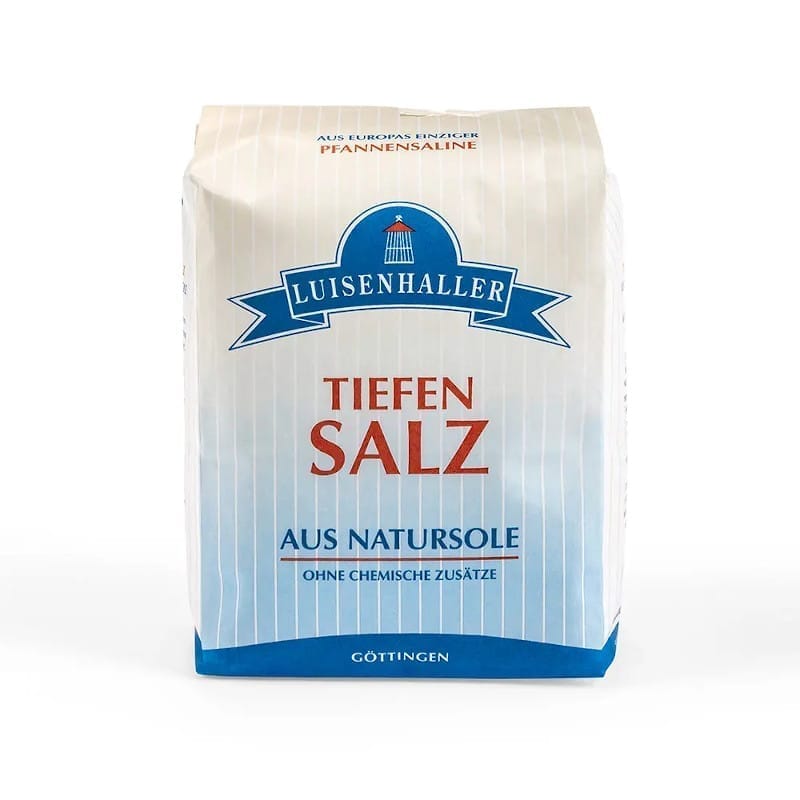
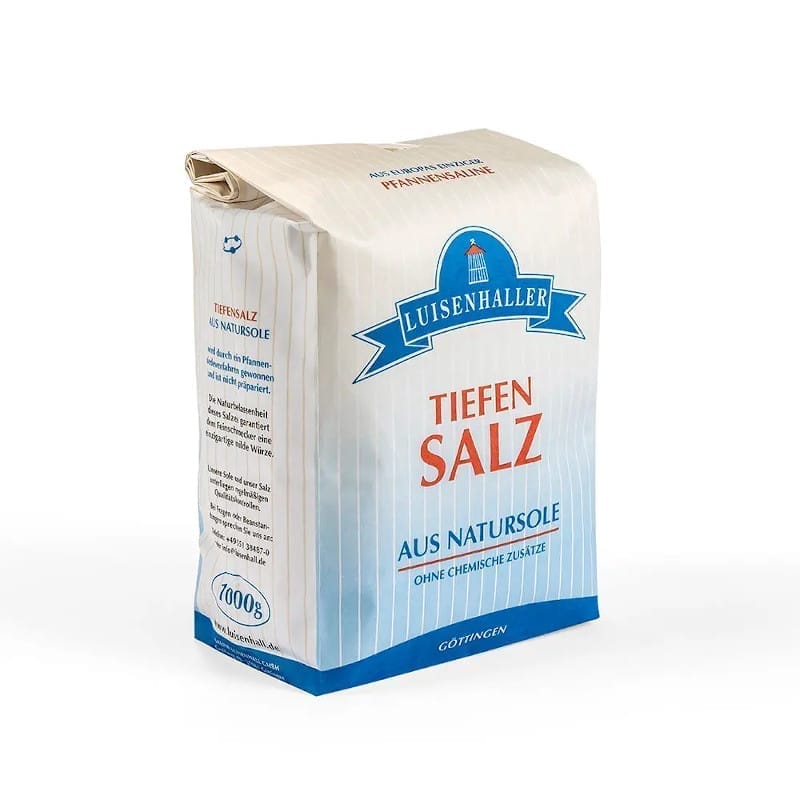
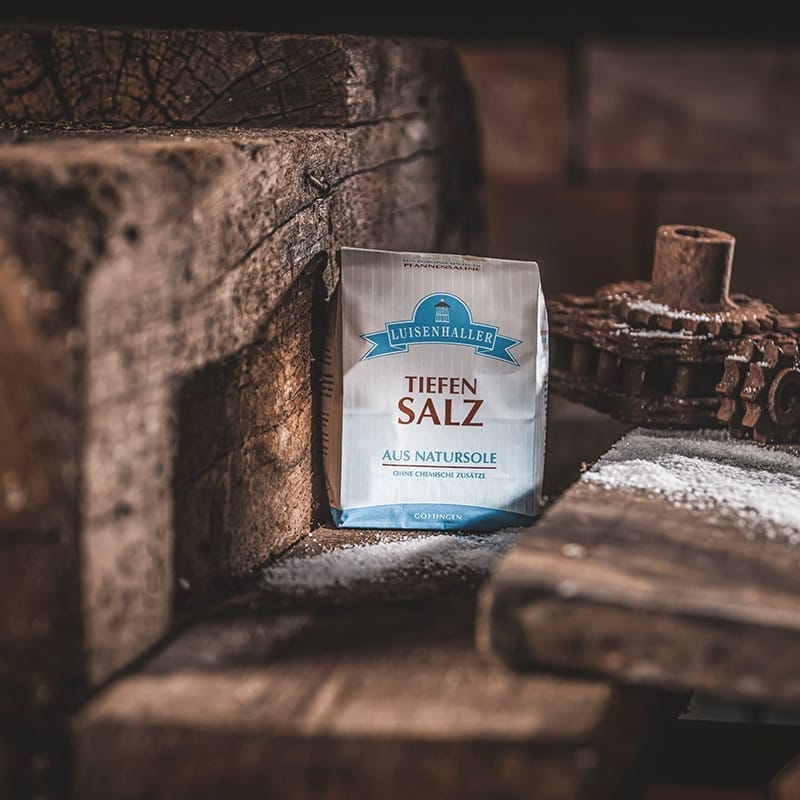
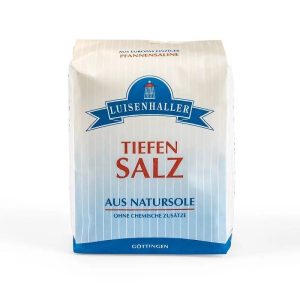
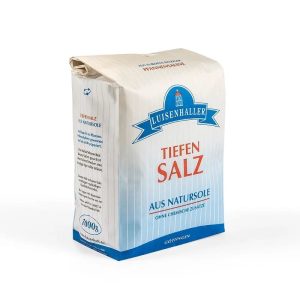
Valfrids is proud to present Luisenhaller Deep Salt, a family-owned business in Göttingen, Germany, with roots dating back to the 19th century. The salt is extracted from a 250 million year old underground pristine ocean 450 meters below ground. It is therefore completely uncontaminated, no environmental toxins have reached it. A genuine craft product!
Luisenhaller deep-mined salt is a multipurpose and gourmet salt commonly used in the kitchen for cooking. It is completely natural, made without treatment or bleaching and free from chemical additives. It is used in the same way as the well-known Celtic salt.
Best kept in a pot or jar with a large enough opening where you can reach in with your fingers. We call it ‘finger salt’. It lacks anti-caking agents and is therefore better suited to a pot or jar with a lid than to a salt shaker.
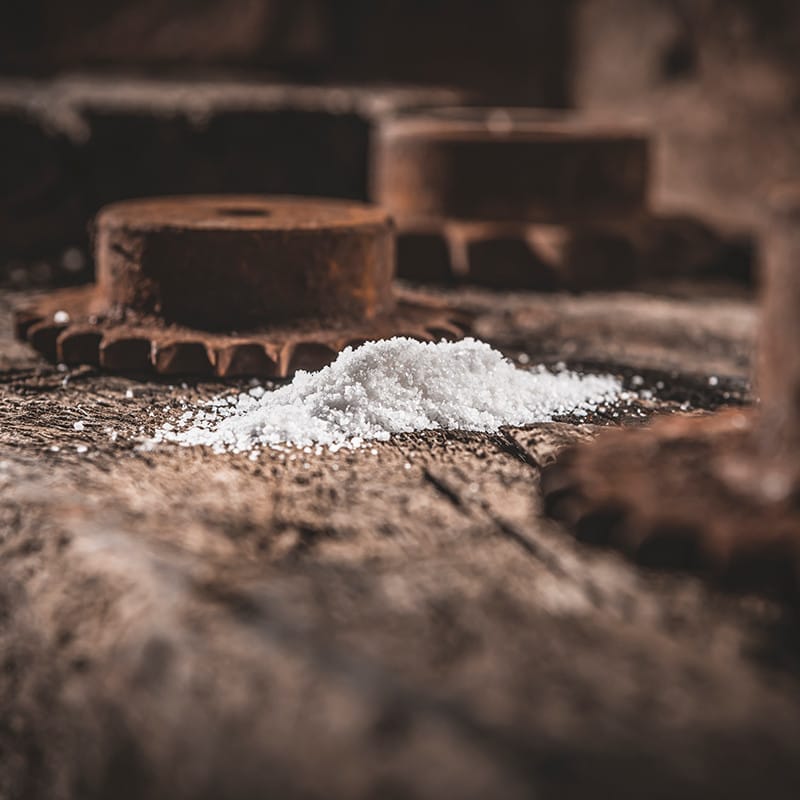
This is a fine-grained salt, but the degree of granulation depends on the cooking temperature in the pan, the outdoor temperature, the humidity and a little on the daily shape of the salt pan. Just like with a classic natural product.
At the bottom of the page you can see the mineral content.
Luisenhaller is the only evaporative saltworks still in operation in Europe. In a whole year, they produce about as much as the big producers do before the lunch break in one day. But the products are not really comparable. Luisenhaller’s salt is extracted as a 27% solution from 250 million-year-old sea salt deposits at a depth of 450 meters. The brine is pumped up and heated in large, shallow pans until the salt crystallizes and can be skimmed off. It is a process that is at least a thousand years old. And apart from the hydropower that was originally used—which was later replaced by electricity—not much has changed at Luisenhaller. It is one of the very few places where you can see how salt was made in the past. The production plant with its massive oak building and technical equipment from the 19th century is a listed building that can be visited by arrangement with the tourist office in Göttingen!


Who was Luise?
There was a time when companies didn’t use globally protected fancy words or cryptic acronyms invented by well-paid design agencies as their names. Instead, they simply bore the name of the owner’s mother.
In Luisenhaller’s case, the name of the mother of the brothers Louis and Theodor Laporte, who bought the saltworks as second owners in 1863. Unfortunately, this brought them no luck. Neither did the geologist Philipp Rohns, who founded the salt works in 1850, and several other owners who came after them, all of whom tried in vain to make the salt works a commercial success. This was first achieved by Hermann Bartold Levin, the son of a Göttingen cloth manufacturer, who took over the salt works in 1881 and, as the forerunner of all subsequent generations, made the business flourish. Luisenhaller was subsequently run successfully by his sons and grandsons and has remained an independent family-owned business to this day; Jörg Bethmann has been at the helm since 1994.
See the photos below from the history of Luisenhaller.


| Composition of Luisenhaller salt. | |
| Analysis by Institut Fresenius. | |
| Sampling number 230991362. | |
| Subject matter | mg/l |
| Total amount of dissolved minerals | 320140 |
| Cations | |
| Sodium | 123000 |
| Magnesium | 522 |
| Calcium | 1700 |
| potassium | 438 |
| Ammonium | 11 |
| Lithium | 1,9 |
| Barium | <0,050 |
| Strontium | 36,6 |
| manganese | 0,66 |
| Iron | 0,78 |
| Iron (bivalent) | 1,1 |
| Anions | |
| chloride | 191000 |
| fluoride | <0,02 |
| Bromide | 74 |
| Iodine | 0,37 |
| Nitrite | <0,005 |
| nitrate | <1,0 |
| Sulfate | 3300 |
| Hydrogen carbonate | 1 |
| Carbonate | <3 |
| Non-dissolved substances | |
| Silicic acid | 5,28 |
| Boric acid | 15,8 |
| Trace elements | |
| Aluminum | <0,005 |
| Antimony | <0,005 |
| arsenic | <0,001 |
| Beryllium | <0,0005 |
| Lead | 0,003 |
| Boron | 3,9 |
| cadmium | <0,0002 |
| Cesium | 0,03 |
| Chromium | <0,002 |
| Cobalt | <0,001 |
| Copper | <0,005 |
| Molybdenum | <0,005 |
| nickel | <0,005 |
| Mercury | <0,0001 |
| Rubidium | 0,55 |
| Selenium | <0,025 |
| Silver | <0,0005 |
| silicon | 1,9 |
| Sulfide | <0,005 |
| Zinc | 0,071 |
| Tenn | <0,001 |
| Weight | 1.018 kg |
|---|---|
| Dimensions | 0.10 × 0.07 × 0.135 m |
2 reviews for Luisenhaller Deep-Sea Salt, 1000 gr
Show only reviews in English (0)
Add a review
KÖPS OFTA IHOP
All about health and food
All about health and food
All about health and food
Frequently bought together
Related products

All products
All products
All products
All products
All products
valleylily –
I was so happy when I found out you were going to sell this salt, because I had used it about 12 years earlier. and actually had about 1 msk left of the sauce in a spice rack. I’ve never felt so comfortable with anything salty. And it’s pretty cool that the nun Hildegard von Bingen, who lived from 1098 to 1179, recommended this salt, and I would recommend it to anyone. There’s no salt that tastes better!
Show original
Blev så lycklig när jag fick reda på att ni skulle sälja det här saltet, för jag jag hade använt det ca12 år tidigare. och hade faktiskt ca 1 msk kvar av salet i ett kryddställ. Jag har aldrig känt mig så trygg med något salt. Och det är rätt coolt att nunnan Hildegard von Bingen, som levde 1098-1179, rekommendrade det här saltet, och jag skulle rekommerndera det till vem som helst. Det finns inget godare salt!
Natalie Werner –
This salt is absolutely amazing! Unrefined, with all minerals and trace elements preserved. My family and I love using it for cooking and sprinkling it on salads—it really brings out the flavor. It tastes really good, and it’s nice to know that it’s a pure, natural salt.
Show original
Det här saltet är helt fantastiskt! Oraffinerat med alla mineraler och spårämnen bevarade. Jag och min familj älskar att använda det till matlagning och att strö över sallader—det förhöjer verkligen smaken. Riktigt gott och känns bra att veta att det är ett rent och naturligt salt.