


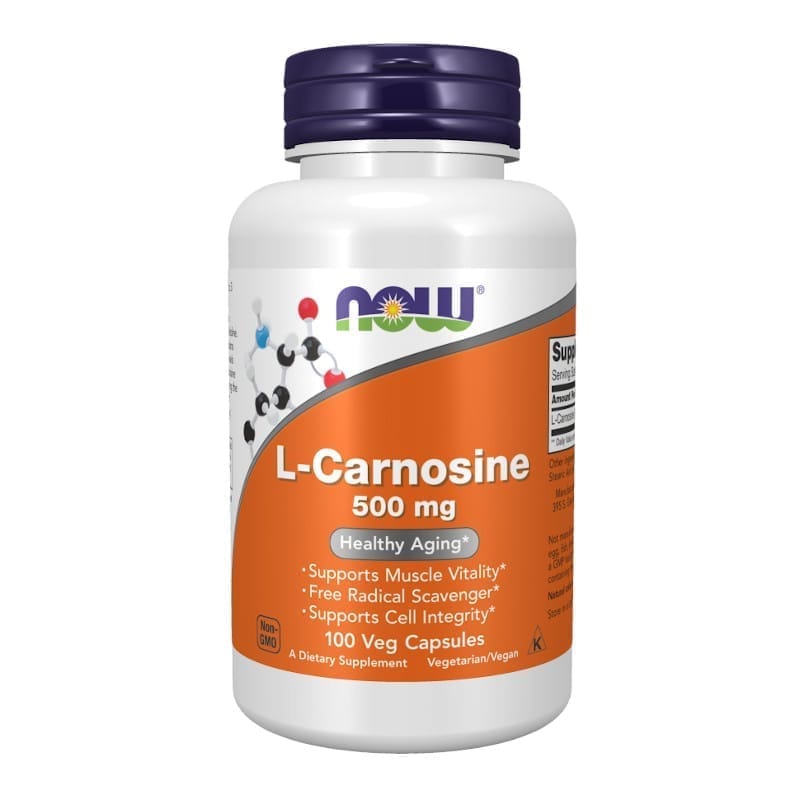
NOW Foods L-Carnosine 500 mg, 100 capsules
L-Carnosine is one of our favorite products. Almost unknown in Sweden. Very interesting in anti-ageing contexts and more. L-Carnosine, in Swedish, is a water-soluble antioxidant that works with other antioxidants such as vitamin E and zinc to enhance their effects, but it does more than that. Carnosine is sometimes called ‘the longevity molecule’.
Blood sugar and aging – Carnosine against AGEs
Carnosine is thought to prevent the effects of diabetes and blood sugar problems, such as neuropathy, kidney problems and eye problems like cataracts. It is considered to limit glycosylation (AGEs), which is one reason why tissues (skin, joints, vessels…) stiffen and lose their flexibility.
AGE stands for advanced glycation/lipoxation end products and are formed when carbohydrates and proteins are heated and processed. Sugar in particular reacts to this. However, AGEs are also formed spontaneously in the body. The amount of AGEs in the body is considered a marker of ageing. Carnosine is therefore also considered to be something of a beauty supplement, especially for skin elasticity.
About a century ago, the French biochemist Maillard discovered that when food was heated, non-enzymatic chemical compounds were formed. They are linked to various health problems and can accumulate in the body. The brown crust on fried food comes from the so-called Maillard reaction.
“Elevated levels of various AGE/ALEs in the body are observed in virtually all chronic diseases: from allergies and Alzheimer’s to various urogenital and eye diseases (Fact 1) [11]. Associations with dairy intake have been reported in diseases such as allergy, certain cancers such as breast, ovarian, prostate and testicular cancer, cardiovascular disease and neurodegenerative diseases such as Parkinson’s disease.”
Quote taken from: https://runnersworld.se/blogg/age-och-ale-inlagget-du-inte/
Non-enzymatic glycosylation:
– Glucose is added to free amino acids on proteins without the help of enzymes.
– The degree of non-enzymatic glycosylation is related to the amount of glucose in the blood.
– The products formed when collagen and other long-lived proteins in the vessel wall are glycosylated undergo a number of chemical modifications over time to form AGEs.
– AGEs cross-link polypeptides and capture plasma or ECM proteins. This means that, for example, LDL is trapped in the vessel wall of larger vessels so that cholesterol deposition there is greater, which speeds up atherogenesis.
– Cross-linking in capillaries traps plasma albumin and contributes to the thickening of their basement membranes seen in diabetic glomerulopathy.
Retrieved from: http://www.medinsikt.se/endokrinologi/diabetes-mellitus/2
Read more about how Carnosine works:
The findings of this review indicate that carnosine has anti-glycating properties, and may hinder the formation of protein carbonyls and the cross-links induced by reduced sugars;
https://pubmed.ncbi.nlm.nih.gov/29858687/
Carnosine and the processes of ageing
https://www.sciencedirect.com/science/article/abs/pii/S0378512216301347
Performance
Athletes use it to boost endurance and muscle strength (including reducing lactic acid).
Heavy metal removal
Carnosine chelates metals such as arsenic, cadmium, lead, mercury, copper and zinc. Chelation therapy can best be described as a cleansing of heavy metals in the body, whereby a substance binds to the metal and the body eliminates it. Chelation is otherwise expensive and is done mainly with EDTA and DMSA. In the United States, it is sometimes given intravenously for cardiovascular problems such as high blood pressure and vasoconstriction. Carnosine can be used in case of copper excess or for detoxification of other heavy metals (mercury, cadmium, etc.). If your hair analysis has revealed high levels of copper, Carnosine may be of interest, or if your hair analysis has revealed other heavy metals.
Carnosine and the brain
Studies suggest that Carnosine may reduce the accumulation of beta-amyloid in brain tissue, which is associated with Alzheimer’s disease. Neurologists call Carnosine a ‘neuroprotector’ and recommend it for depression, anxiety, dementia, Alzheimer’s and Parkinson’s disease. Autistic children have also been treated with positive results.
Stomach problems
Carnosine can potentially have a preventive effect on stomach problems. There is a stomach medicine containing zinc and L-Carnosine (Polaprezinc).
Detoxification
It helps to eliminate aldehydes and acts preventively on alcohol damage.
Carnosine is naturally found in food
Carnosine is naturally found in food, for example in beef and salmon. It occurs naturally in the body, especially in our muscle fibers, where it acts, among other things, to regulate the pH of blood and cells. Precisely because it is not a substance unknown to the body, the supplement has no side effects whatsoever – even in children. There is a risk of getting too little in your food, especially for low-protein eaters or vegetarians.
Carnosine is a ‘dipeptide’, which is an organic compound consisting of two amino acids (histidine and beta-alanine). L-Carnosine is not the same as L-Carnitine (L-Carnitine).
Note that Carnosine may have a mild antihypertensive effect.
Feel free to search online and see what you can find about L-Carnosine, “the longevity molecule”.
For example here: https://www.lifeextension.com/magazine/2016/12/carnosine
and here in Swedish: https://ensueco.com/3857-carnosin-ett-medel-med-antialdrande-effekt/
Use:
1 capsule, one to three times daily with meals.
Ingredients:
L-carnosine (ß-alanyl-L-histidine), hypromellose (cellulose capsule), stearic acid (vegetable source) and magnesium stearate (vegetable source).
100 capsules. Vegetarian capsule casing.
| Weight | 0.1 kg |
|---|---|
| Dimensions | 0.06 × 0.06 × 0.11 m |
Related products

All products

All products

All products
All products

All products
All products